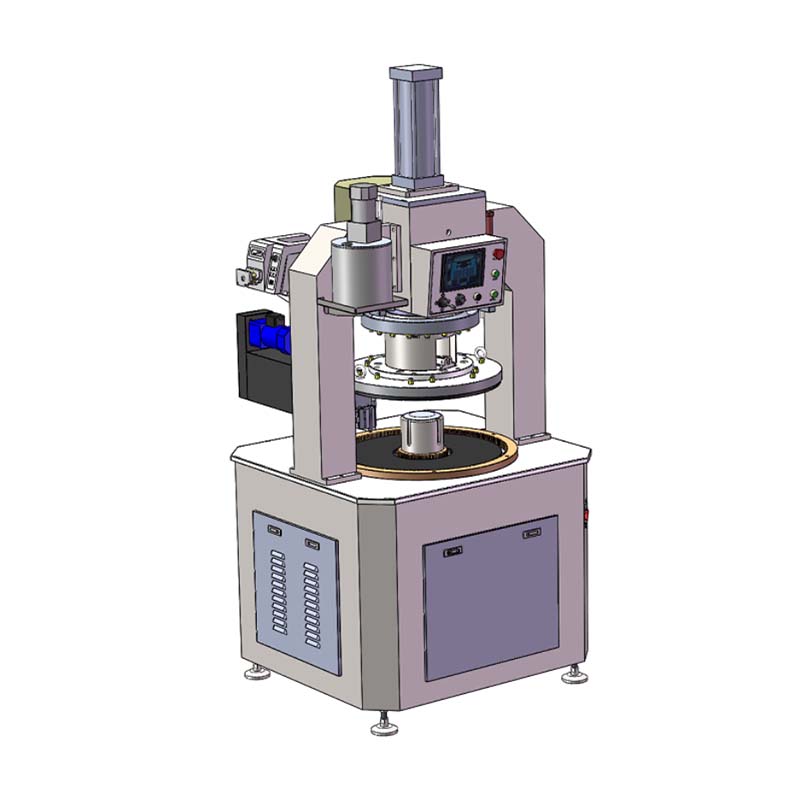
Sapphire Double-Side Lapping Machine typically uses diamond lapping plates.,What are the advantages?
As a typical hard and brittle crystal material, sapphire has a Mohs hardness of 9, only lower than diamond. Its double-sided precision lapping imposes stringent technical requirements on the hardness, wear resistance and dimensional stability of lapping plates. Thanks to their inherent material properties, diamond lapping plates have become core matching components for
Sapphire Double-Side Lapping Machine. Compared with conventional lapping plates such as CBN and high-phosphorus cast iron, they offer irreplaceable advantages in machining accuracy, production efficiency and long-term operational stability. An authoritative and rigorous analysis is provided below from the perspectives of material science and processing engineering.
Super high hardness and wear resistance, precisely matching sapphire processing requirements. Diamond abrasives have a Vickers hardness (HV) of 10,000–12,000, much higher than that of sapphire (HV 2,000–2,500), enabling efficient material removal on sapphire surfaces and avoiding efficiency degradation caused by rapid abrasive wear. Compared with ordinary CBN lapping plates, diamond lapping plates improve wear resistance by 3–5 times, reducing lapping plate replacement frequency and equipment downtime maintenance costs. They also avoid deviations in equipment coaxiality and flatness caused by frequent plate changes, ensuring stable machining accuracy.
Excellent dimensional retention guarantees consistent processing. After ultra-precision grinding, diamond lapping plates can stably control flatness and parallelism tolerances within ±2 μm. During long-term continuous lapping, abrasives wear uniformly without obvious deformation, chipping or shedding, consistently maintaining flatness and thickness tolerance consistency in double-sided processing of sapphire workpieces. This fundamentally eliminates workpiece scrap caused by degraded lapping plate accuracy, suitable for mass precision machining of high-end sapphire products.
Synergistic optimization of lapping efficiency and surface quality. Diamond abrasives feature sharp and uniformly distributed cutting edges, increasing sapphire material removal rate by 40%–60% and significantly improving machining efficiency. The stable cutting process effectively reduces defects such as chipping, microcracks and surface scratches common in machining hard and brittle sapphire materials. Paired with special sapphire lapping fluid for efficient chip removal and cooling, workpiece surface roughness (Ra) can be controlled within 0.01 μm, meeting processing requirements for optical-grade and electronic-grade sapphire products.
In summary, the hardness, wear resistance and dimensional stability of diamond lapping plates highly match the stringent demands of sapphire double-sided lapping. They serve as core support for ensuring machining quality, improving production efficiency and reducing operation and maintenance costs. Their technical advantages have been widely verified in industries such as semiconductors and optical devices, providing reliable assurance for high-precision machining of high-end sapphire.







 English
 русский
 한국어
한국어 Deutsch
 español
 italiano
 العَرَبِيَّة