How does the Stainless Steel Double-Side Lapping Machine overcome the technical difficulties in precision machining of high-hardness thin plates?
The
Stainless Steel Double-Side Lapping Machine is a precision planetary ultra-precision lapping equipment tailored to the material characteristics of stainless steel. Aiming at the processing pain points of stainless steel such as high hardness, high toughness, poor thermal conductivity and easy deformation of thin-walled parts, it breaks through the precision limitations of ordinary lapping equipment and realizes one-time double-sided precision forming of thin plates, sealing rings, valve plates, precision gaskets and other parts.
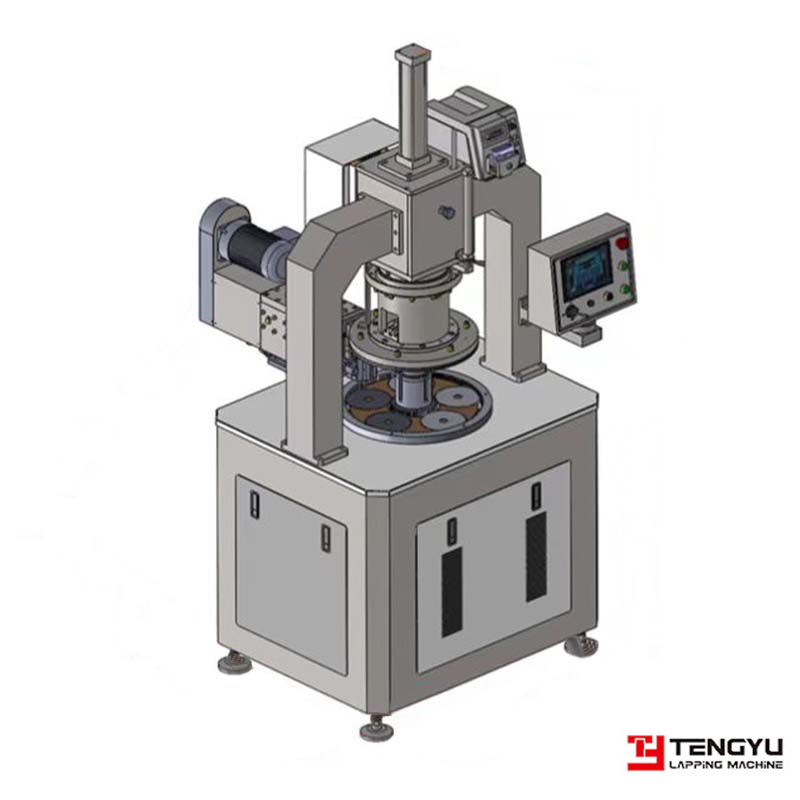
The equipment adopts a planetary differential transmission structure, consisting of upper and lower lapping discs, sun gear, planet carrier, variable frequency drive unit, precision constant pressure control system and lapping liquid circulation mechanism. During processing, the workpiece is limited in the clamping groove of the planet carrier, performing both revolution and rotation along with the planetary mechanism. Combined with the reverse operation of the upper and lower lapping discs, it forms a full-coverage lapping track with equal cutting capacity. Secondary clamping for flipping is not required, fundamentally eliminating positioning errors, cumulative tolerances and clamping deformation.
The whole machine adopts a high-rigidity bed frame structure to effectively suppress vibration and micro-deformation. Segmented precision constant-pressure feeding is adopted to match reasonable lapping pressure, disc speed and abrasive grain size according to different stainless steel grades such as 304 and 316. The lapping liquid is supplied in a constant-temperature circulation manner to timely take away grinding heat and micro-chips, reduce thin plate warpage induced by thermal stress, and ensure dimensional stability and flatness accuracy.
With standardized process configuration, the equipment can stably achieve micron-level flatness, submicron-level parallelism, mirror-level surface roughness, and high consistency of thickness tolerance for batch workpieces. It is now widely used in hydraulic sealing, medical devices, precision instruments, semiconductor supporting and other fields, serving as an indispensable core process equipment for mass production of stainless steel thin-wall precision components.







 English
 русский
 한국어
한국어 Deutsch
 español
 italiano
 العَرَبِيَّة